

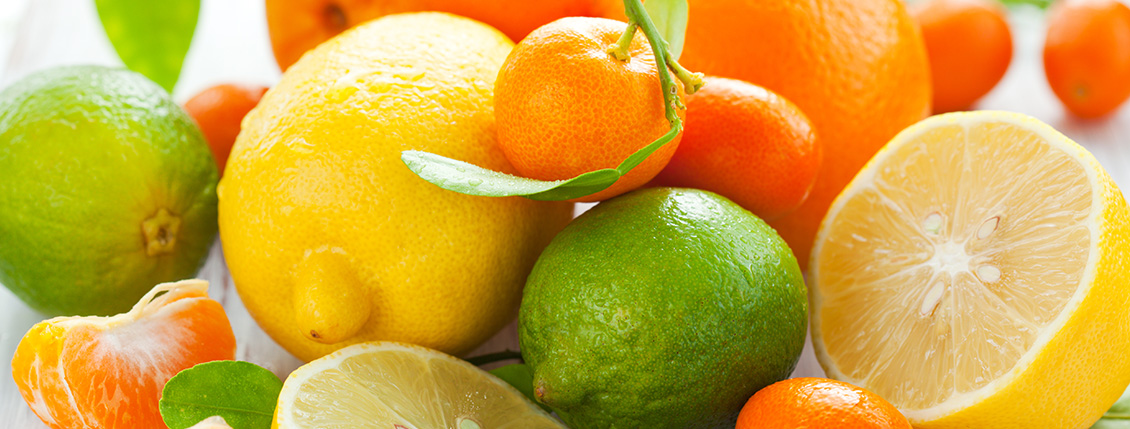
Everyone's familiar with citrus fruits, but not everyone knows all the different types and attributes of lemons, limes and oranges. Learn more about citrus types and applications below, and make informed purchasing decisions.
Popular Lemon Varieties

Lemons
While there are several varieties of typical lemons, they are virtually indistinguishable.
Primary Applications and Attributes
- Knobby, firm, medium-thick, bright yellow skin, neck may be short to non-existent at the stem end, while the blossom end may be knob-shaped or tapered to a slight point.
- Has some seeds; a yellow, juicy flesh; a very tart juice; and a fragrant, oily peel.
- Use zest and juice to accent salads, beverages or cocktails, baked goods, poultry, seafood or in marinades as a natural tenderizer.
Lemon Sizing and Pack Count
| Size | Description | Case Net Weight | Serving Information | Average Diameter |
|---|---|---|---|---|
| 115 ct. | Lemons, Fresh Domestic/Imported | 35-40 lbs. | 5.57 oz. Avg. Each | 2.410" |
| 140 ct. | Lemons, Fresh Domestic/Imported | 35-40 lbs. | 4.57 oz. Avg. Each | 2.240" |
| 165 ct. | Lemons, Fresh Domestic/Imported | 35-40 lbs. | 3.88 oz. Avg. Each | 2.130" |
| 200 ct. | Lemons, Fresh Domestic/Imported | 35-40 lbs. | 3.20 oz. Avg. Each | 2.010" |
| 235 ct. | Lemons, Fresh Domestic/Imported | 35-40 lbs. | -- | 1.880" |
Notes:
- Traditionally, sizing designation for citrus is determined by how many uniformly, sized items would fit in a traditional carton
- Today, the numbers seen in the product description refer to the size, rather than how they are packed
- Lemons are typically referenced by the lemon count
- Case weights typically range from 35-40 lbs., but smaller pack sizes may be available
- A lemon at room temperature will yield more juice than a cold lemon, but cold lemons yield the most zest
- One case of 115/140 count lemons equals 21 cups of fresh juice. One lemon equals 3 tbsp. grated peel
Lemon Grading Requirements
Lemon Storage and Handling
- Maintain adequate air ventilation during storage
- Keep cartons off the floor to help prevent dampening of boxes from condensation of moisture in the room and for food safety
- Store lemons away from foods with strong odors and ethylene-producing fruits
- Ideal storage temperature: 45 - 50°F in the red zone of the cooler
- To preserve the fresh appearance of lemon wedges after they are prepared, refrigerate in covered containers
Popular Lime Varieties
Limes
While there are several varieties of typical limes, they are virtually indistinguishable.
Primary Applications and Attributes
- Elongated to round shape, with thin, smooth, shiny skin.
- Typically sold while still dark green; gradually turns light green when ripened.
- Internal segments are light pale green in color and have few seeds, if any. Distinctive piney, floral flavor and spicy aroma notes.
- Use lime wedges, cartwheels and twists in cocktails and other beverages. Add freshly squeezed lime juice to stir-fry or guacamole.
- Add lime zest to butter, plain vegetables, grilled meat, fish and poultry.
Lime Sizing and Pack Count
| Size | Description | Case Net Weight | Serving Information | Average Diameter |
|---|---|---|---|---|
| 110 ct. | Limes, Fresh Domestic/Imported | 35-40 lbs. | 5.82 oz. Avg. Each | 2.625" |
| 150 ct. | Limes, Fresh Domestic/Imported | 35-40 lbs. | 4.27 oz. Avg. Each | 2.375" |
| 175 ct. | Limes, Fresh Domestic/Imported | 35-40 lbs. | 3.66 oz. Avg. Each | 2.25" |
| 200 ct. | Limes, Fresh Domestic/Imported | 35-40 lbs. | 3.20 oz. Avg. Each | 2.00" |
| 225 ct. | Limes, Fresh Domestic/Imported | 35-40 lbs. | 2.84 oz. Avg. Each | -- |
| 230 ct. | Limes, Fresh Domestic/Imported | 35-40 lbs. | -- | 1.938" |
| 250 ct. | Limes, Fresh Domestic/Imported | 35-40 lbs. | -- | 1.875" |
Notes: Let limes warm up to room temperature for a hour before squeezing them, to maximize juice yield.
- Traditionally, sizing designation for citrus was determined by how many uniformly sized items would fit in a traditional carton
- Today, the numbers seen in the product description refer to the size, rather than how they are packed
- Limes are typically referenced by the count
- Case weights typically range from 35-40 lbs., but smaller pack sizes may be available
Lime Grading Requirements
Lime Storage and Handling
- Store limes in a well-ventilated area and away from direct sunlight
- Keep cartons off the floor to prevent boxes from becoming damp, and for food safety
- Handle limes with care to avoid bruising and internal decay
- Ideal storage temperature; 52 - 58°F in the black zone of the cooler
Popular Orange Varieties
Cara Cara
Primary Applications and Attributes
- Outward appearance is similar to other navels, but interior is a distinctive pinkish red, due to natural presence of Lycopene.
- Flavor resembles a rich, orange taste. Has an exceptionally sweet flavor with a tangy cranberry-like zing, with overtones of raspberries and strawberries.
- Cara Cara oranges may be eaten on their own or added to fruit salads or juices.
Orange Sizing and Pack Count
| Size | Description | Case Net Weight | Serving Information | Average Diameter |
|---|---|---|---|---|
| 48 ct. | Oranges, Fresh Domestic/Imported | 35-40 lbs. | 13.3 oz. Each | 3.47" |
| 56 ct. | Oranges, Fresh Domestic/Imported | 35-40 lbs. | -- | 3.30" |
| 72 ct. | Oranges, Fresh Domestic/Imported | 35-40 lbs. | 8.89 oz. Each | 3.04" |
| 88 ct. | Oranges, Fresh Domestic/Imported | 35-40 lbs. | 7.27 oz. Each | 2.84" |
| 113 ct. | Oranges, Fresh Domestic/Imported | 35-40 lbs. | 5.66 oz. Each | 2.60" |
| 138 ct. | Oranges, Fresh Domestic/Imported | 35-40 lbs. | 4.64 oz. Each | 2.42" |
| 163 ct. | Oranges, Fresh Domestic/Imported | 35-40 lbs. | 3.93 oz. Each | 2.29" |
Notes:
- Traditionally, sizing designation for citrus was determined by how many uniformly sized items would fit in a traditional carton
- Today, the numbers seen in the product description refer to the size, rather than how they are packed
- Oranges are typically referenced by the count. Oranges may be available as a range of sizes to be used specifically for juicing
Grades of California and Arizona Oranges Requirements
Grades of Florida Oranges Requirements
Grades of Texas (and States Other Than Florida, California and Arizona) Oranges Requirements
Orange Storage and Handling
- Store oranges in a well-ventilated area; keep cartons off the floor to prevent boxes from becoming damp
- Keep oranges separated from foods that absorb odors – such as eggs, apples, cheese or butter
- Oranges are typically stored closest to the cooler door in the red zone of the cooler